Quantum Polycontextural Computation · 15 October 2026
The QPC quantum computer
From quantum computation on IBM Heron to a native QPC processor
Dr. Ilan Kreitmann · quantumpolycontextural.ai
QPC computes on IBM Heron today. The next stage is a QPC-native quantum computer, the same architecture built as dedicated hardware, and we are designing it now.
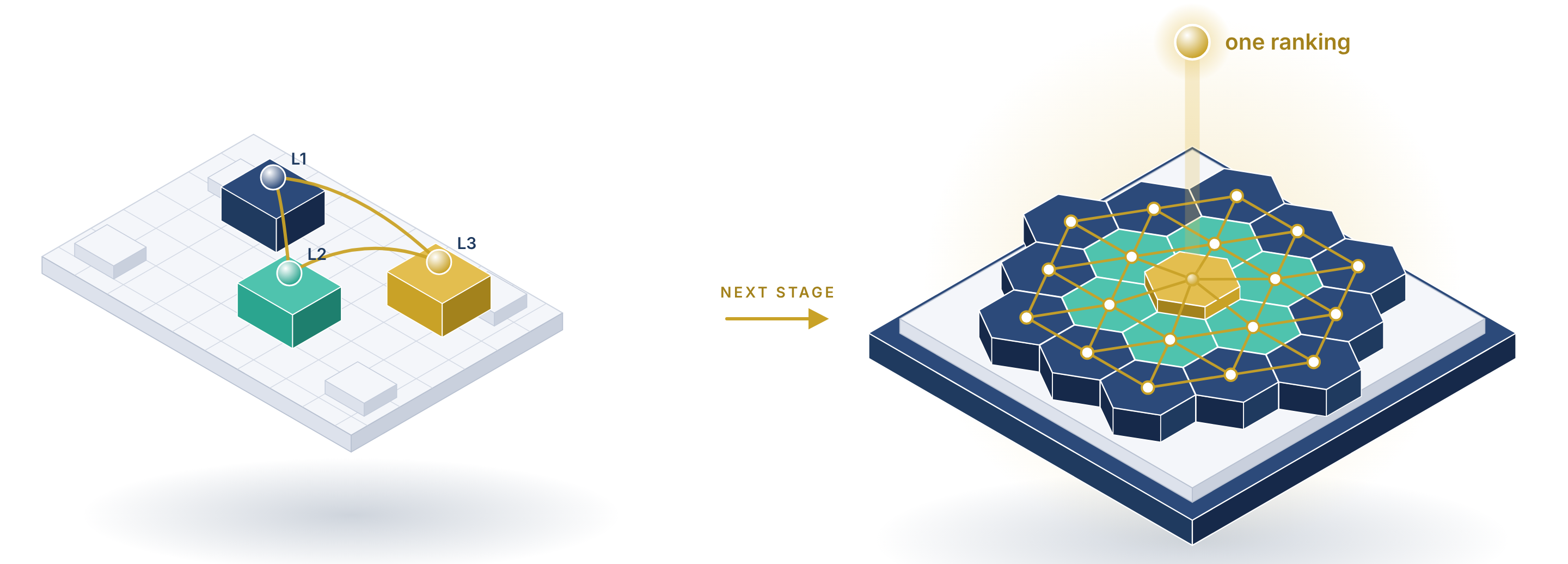
Left: co-resident logics coupled in one job on IBM Heron r2, today. Right: the native QPC processor, in design.
Quantum logic on a quantum computer
QPC is a quantum computation. Superposition, entanglement, interference and measurement carry a whole decision in one job. Sixty-two documented jobs on quantum hardware show that this computation runs. The native QPC computer is the machine built for it.
A QPC computation holds several decision logics on the processor at the same time. Each logic occupies its own contexture, a register of the circuit. Inside that contexture the alternatives stand in superposition. Transjunctions, junction qubits on the processor, couple the contextures while the state evolves: that coupling is entanglement across logics. Interference shapes which joint outcomes carry weight. Measurement closes the job.
The reported result is a measured property of the quantum state. The ranking is read from the counts of that one job. The relation between the logics lives in the quantum state of that sitting.
TODAY · PROVEN
What already computes on IBM Heron
QPC runs this architecture on IBM Heron r2 processors of 156 qubits, with public job identifiers that anyone can check.
Kinase selectivity, ibm_kingston, job da632keaa69c739lgpag. Intended targets, collateral targets and safety kinases on the public Davis 2011 panel held together in one job. Imatinib 0.610 over dasatinib 0.547. Raw junction gap 0.197.
Photomask synthesis, ibm_kingston, job daas1burrl7c73860bd0. Six masks from the public ICCAD-2013 benchmark under twenty-four measured contextures on the full 156-qubit register. The uncorrected mask led at 0.622 against the inverse-lithography mask at 0.460, against the pre-registered industry expectation.
The coupling does work. The same 78-qubit circuit ran with transjunctions on and off. On raw counts the coupled run carried a localised joint-structure gap of +0.056 on ibm_fez and +0.061 on ibm_marrakesh. The joint structure comes from the coupling, measured on the hardware.
QPC has completed 62 documented jobs on IBM, IonQ, IQM, Pasqal, QuEra, Origin and Quantinuum hardware. Those jobs establish the computation class on today's large processors.
Why the architecture needs its own machine
IBM Heron is a general-purpose processor with a fixed lattice of connections. When QPC places several contextures on it, every transjunction between contextures that sit apart on that lattice is routed through additional gates. Routing adds circuit depth, and depth is where noise enters. On the full-register portfolio run on ibm_marrakesh, the coupled circuit reached a depth of 119 after routing.
A QPC-native processor removes that cost at the source. Its layout follows the architecture: contexture tiles hold the parallel logics, and the coupling fabric places its couplers exactly where the contextures meet. The same decision runs without routing overhead, with a shallower circuit, and with the joint structure carried by the hardware itself.
NEXT · IN DESIGN
The native QPC computer
Contexture tiles hold the logics of the decision. The native coupling fabric is the entanglement hardware between them. End-of-run readout closes the job and returns the counts from which the ranking is read.
The first model follows the superconducting path. The die operates at millikelvin, the same cold class as IBM Heron. The classical controller and the operator sit at room temperature. Processor, control and operating envelope form one QPC computer: decision table in, ranking out, with the full run record.
The first model is one expandable set of tiles. Later generations add tiles of the same design, growing toward the size of today's largest processors while remaining a QPC computer.
How we will prove it
The native computer will meet the same standard as every QPC job. We will run the kinase selectivity desk on the first QPC die and on ibm_kingston, with the panel, the expected outcome and the pass bar registered before both runs. We will publish circuit depth, raw junction gap, the ranking and the job record for both machines, side by side. The architecture's advantage as hardware is a measured comparison on both machines.
The 156-qubit Heron desks are the live public proof of the computation class, and the work on IBM continues.
What this class of computer delivers
Decisions judged on several properties at once: a lead series on activity, selectivity and safety; a lithography method on several manufacturing measures; a portfolio on return, risk and volatility. QPC holds those properties together on the processor and reads the order out once. The native QPC computer is the machine for that class of work.
Reports and job identifiers: quantumpolycontextural.ai. Method paper: zenodo.org/records/22831221.
Home
Kinase run on Kingston
Photomask result